Sacrifice is just another word for solidarity in Ukraine today
In Ukraine today, “solidarity” means self-dedication and sacrifice — and is more tangible than ever before.

A scholarly journal from the Centre for Baltic and East European Studies (CBEES) Södertörn University, Stockholm.
 Issue 2026, 1: Download.
In Ukraine today, “solidarity” means self-dedication and sacrifice — and is more tangible than ever before.
To speak of a solidarity beyond sense or meaning does not imply that the solidarity in question lies beyond the world, or beyond existence. What Patočka is trying to come to terms with is rather a solidarity at the limits of existence and at the limits of experience: the experiences of the limits of existence.
The term “fraternity” has been clearly linked to a register that could be called romantic. This explains the desire to distinguish the word from others like “solidarity” and “justice” and in particular “equality”.
In 1980, women’s participation in the Solidarność movement was far from invisible. Women were present from the start and they “took over” several highly important activities in Solidarność after its de-legalization in December 1981. The invisibility of these tasks was compounded by the fact that all of this work was illegal.
The author analyzes the content of the word “solidarity”, not for the sake of linguistics, but in the belief that words contain memories as well as many other experiences, often conflicting ones. He also talks about Solidarity, the trade union in Poland, which was created in August 1980 and crushed in December 1981.
Ludger Hagedorn has gathered together different voices, all adding insights into the meaning of solidarity. Here he presents the different contributions and place them in a wider context. He concludes, "Perhaps the outcome of solidarity counts less than the atmosphere that it creates and in which it unfolds its explosive message.".
Your advertisement in Baltic Worlds reaches a specialised, academic target group. Baltic Worlds contributes to the dissemination of knowledge about […]
An interview with Russian human rights activist Elena Vasilyeva, founder of the group “Load 200 from Ukraine to Russia.” that gathers information about soldiers killed in military operation zones abroad and then transported home. The article contains statements that reflect the views of the author and the interviewed, not necessary the view of Baltic Worlds'.
During the May 25 presidential election, the leaders of Svoboda and the Right sector had only 1, 7 percent of support. This is, according to Lyudmyla Pavlyuk, professor in journalism in Ukraine, an argument that the Russian official propaganda about Ukraine’s “fascism” is a way to legitimize Russian policies of occupation and aggression.
The ambiguity of the 1920s Ukrainianization is well known among its scholars. A curious fact is that was becoming less intense and effective where the initial positions of the Ukrainian were weaker. Donbas was specifically one such region. If Ukraine is a borderland, Donbas is a borderland multiplied by itself, notes the author and further claims that "Donbas will retain its hybridity no matter the outcome of the current unrest. Still, the volatile situation brings not only risks but also yet another chance for belated modernisation."
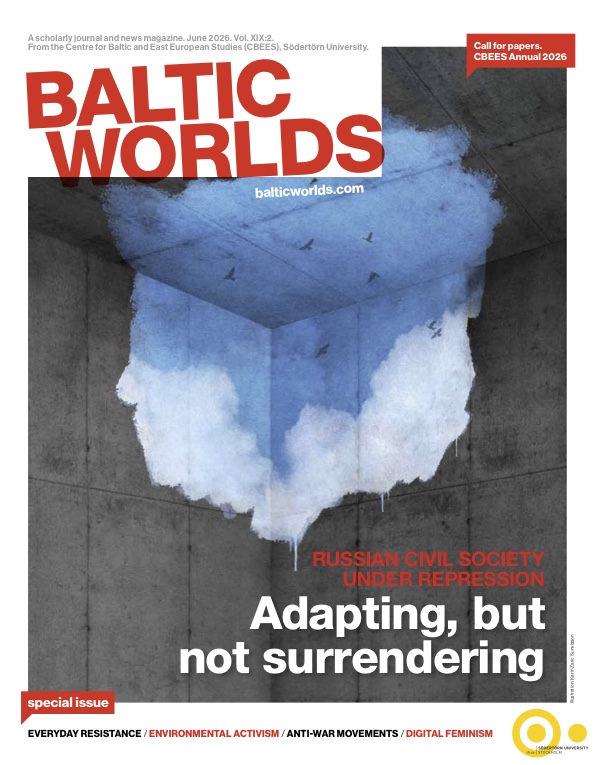 Issue 2026, 2: Download.
 Baltic Worlds covers; the Baltic Sea Region, Eastern Europe, Russia, CentralAsia, Caucasus and the Balkan area.