Peer-reviewed articles have all been through a peer-review process. We practice double-blind peer-review. All material is reviewed by two independent specialists at least at post-doc level. A prerequisite for publishing scientific articles in Baltic Worlds is that the article has not already been published in English elsewhere. If an article is simultaneously being considered by another publication, this should be indicated when submitting.
In 2016, commemorations of the 60th anniversary of the 1956 Hungarian Revolution brought new conflicts in memory politics. This article analyzes the reasons for women’s absence from the historiography of the 1956 Revolution and discusses how the polypore state is using the populist turn to introduce hegemonic narratives and to include women in the narrative of “national feminism”.
By
Andrea Petö
March 8, 2018
The article describes Ukrainian views on the war in the eastern region of the country and other worries of the people as well as Ukrainian-Russian relations and the views on the EU. The empirical material is from opinion polls carried out by the Kyiv International Institute for Sociology in 2014–2017. The conflict in the east is the main concern of the population.
By
Simo Mannila and Natalia Kharchenko
March 8, 2018
In his contribution to the volume Russian Literature since 1991 entitled “The Postmodernist Novel”, Mark Lipovetsky makes the now rather widespread claim that the Russian postmodernist post-Soviet novel represents a break with the totalizing tendencies of the socialist realist novel and opens for new ways of experiencing and conceptualizing the world. In this paper this claim is critically examined on the basis of a reading of Viktor Pelevin's Chapaev i Pustota (transl. as Buddha’s Little Finger or Clay Machine Gun against the backdrop of contemporary debates about realism and simulacra. Here it is argued that the Soviet myth of Chapaev lends itself to the totality of the private myth.
By
Tora Lane
November 10, 2017
The article provides a closer reading of Walter Benjamin’s essays Experience and Poverty and Moscow, by juxtaposing the records of his visit to Russia in 1926–1927 with the author’s reflections on the nature of the transformations in the urban space of an early Soviet city. By using the dystopian image of Mickey Mouse as the desired inhabitant of modernity introduced by Benjamin in Experience and Poverty, Seits gives the allegorical and comparative interpretation to the substantial changes in the living space of Moscow that were witnessed by Walter Benjamin.
By
Irina Seits
November 10, 2017
A Day of the World (Den’ mira) was a documentary volume, published in 1937, that was intended to provide a snapshot of the entire globe on a single day, September 27, 1935. The tensions within and around A Day of the World capture some of the basic contradictions in socialist realism, the official aesthetic method of Soviet art: between publicity and intimacy and between the dream of synchronous, global revolution and the aberrant temporalities of individual experience.
By
Robert Bird
November 10, 2017
In the present article, the main principles of the reforms in Revolutionary Russia in the sphere of art are analyzed through the example of the reorganization of the Higher Artistic School of the Imperial Academy of Arts of St. Petersburg into the Free Art Studios (Svomas). The studios were to become a tool for the transformation of the surrounding reality and for the development of the artistic consciousness of the people. The intended result of those transformations was the complete spiritual and material harmonization of society, while the perfection of artistic interpretation was to be replaced with the perfection of social living. The research presented here is based on the archival materials and is one of the very first publications on the problems associated with the reform of artistic education in the first post-revolutionary years.
By
Mikhail Evsevyev
November 10, 2017
The paper is a study of the Ukrainian popular culture based on the material of the Ukrainian TV comedy shows which emerged after 1991. They are: Maski Show, Gentlemen Show, Verka Serduchka, Fajna Ukrajna, Vital’ka, and Evening Kvartal. These TV shows have not been investigated by Western, nor Ukrainian scholars. The Ukrainian TV comedy shows are examined in the context of Bakhtin’s theory of carnival and of the ideas of the Australian Slavic scholar M. Pavlyshyn who has elaborated the concepts anticolonialsim and postcolonialism in relation to contemporary Ukrainian culture.
By
Viktoriya Sukovata
June 19, 2017
This paper traces the emergence of various digital technology-driven policy ideas in Estonia during the last two decades. The article is specifically concerned with the idea of e-Estonia, a signifier that is widely used as shorthand to denote Estonia’s success in developing digital solutions in government, public management, business, education, etc. The paper analyzes the idea of e-Estonia to disclose, contextualize, and critically explain the particular discursive practices that constitute the e-Estonia discourse. It offers a discourse-theoretical reading of e-Estonia in terms of different types of discursive ‘logics’. Finally, the paper argues for the importance of recognizing what is at stake in the act of naming e-Estonia.
By
Rene Mäe
June 19, 2017
Juxtaposing the postcolonial in-betweenness of critical discourse with Bakhtin’s idea of hybridized, collusive and hidden dialogicality, the postcolonial memoir can be read as the self’s mapping of a paradigm shift in contemporary times. The postcolonial memoirs become a site of contested, unsettling and endless renegotiations. I shall read South Asian-American diasporic writer Meena Alexander’s 1993 Fault Lines: A Memoir and the revised 2003 version as dialogic texts. Alexander’s memoirs engage, contest and alter each other to disrupt the possibility of singular meanings and absolute truth. Instead, the texts offer a conflicting and incommensurate idea of the past and a fractured yet intensely interconnected vision of the present.
By
Paromita Chakrabarti
June 19, 2017
The Russian Byzantinist Sergei Averintsev writes in a critical article about laughter in Bakhtin’s interpretation of popular medieval culture that Bakhtin makes laughter too absolute and that he was wrong in maintaining that it has nothing to do with violence. I apply the reasoning of both authors on a historical phenomenon: the witch trials in Sweden, focusing on one precise geographical place. There seem to be many factors behind the witch trials, but their cultural manifestations demonstrate the qualities of reverse or carnival, culture although without having laughter as their main feature, and including violence as a main element.
By
Per-Arne Bodin
June 19, 2017

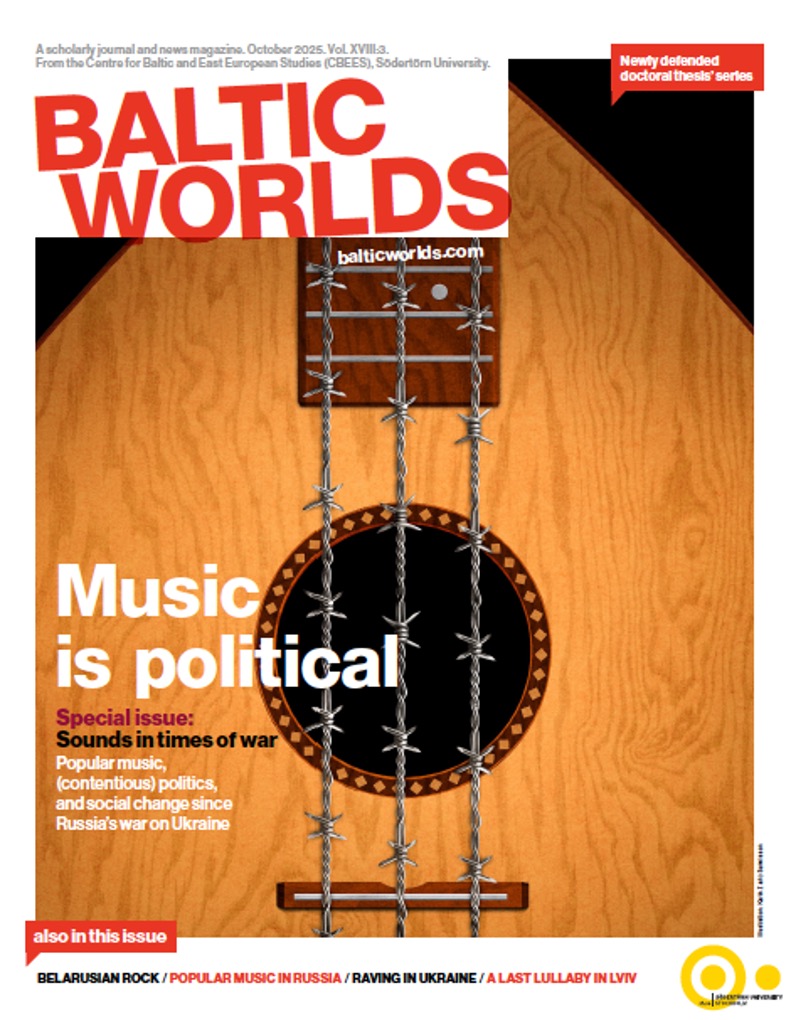 Issue 2025, 3:
  Baltic Worlds covers; the Baltic Sea Region, Eastern Europe, Russia, CentralAsia, Caucasus and the Balkan area.