98 articles tagged with ukraine were found.
The article explores how the ongoing Russian–Ukrainian war is transforming the discussion around the oral history method under the conditions of an active war and analyzes the potential of the graphic novel as a new form of publishing oral history sources. The focus is on the theoretical, methodological, and practical dimensions of oral history, as well as on the question of which forms of public representation become relevant in the situation of an ongoing event. Drawing on the project “Graphic Narratives about the War” (archival interviews from the 1990s and new recordings from 2022–2024, created in cooperation with the NeuengammeConcentration Camp Memorial), the article demonstrates how the combination of interviews and original graphic art influences the construction, interpretation, and affective perception of narratives. The theoretical section of the article outlines key conceptualizations of oral history as theory, method, and practice, distinguishes between “documentation” and “oral history” within the context of the “unfinished past,” and argues for the ethical foundations for choosing the graphic format. The empirical section describes the working process — from selecting and transcribing interviews to script adaptation, collaboration with artists, and decisions regarding content, form, format, and dissemination of the publication. The study contributes to current discussions on oral history in times of crisis, and public humanities, proposing the graphic narrative as a safe and meaningful tool for representing oral testimonies in the context of an ongoing war.
By
Svitlana Telukha
December 18, 2025
The international conference “Russia Through the Eyes of Its Neighbours: The Ongoing War and Regional Security” which was held in Stockholm on September 18–19, 2025, brought together leading scholars and policy experts from across Europe, providing a platform to assess how Russia’s ongoing war against Ukraine continues to reshape the geopolitical and security landscape of the region.
By
Victoria Leukavets and Joakim Ekman
December 9, 2025
Yurii Latysh, PhD (Candidate of Historical Sciences), visiting Professor of State University of Londrina (Brazil), deputy editor-in-chief of the journal Historical Expertise (Istoriceskaja Ekspertiza), in a discussion with Denys Kiryukhin on how the Russo-Ukrainian war has affected the politics of memory in Eastern Europe.
By
Denys Kiryukhin
November 21, 2025
This essay, based on broader research on independent radio stations from Kyiv, Gasoline Radio and 20ft Radio, and an independent label, Shukai, looks at how these sound media can engage with cultural history and offer different ways to think about archiving. Through applying Diana Taylor’s use of repertoire to three specific sound examples (a radio show, an installation, and a record), I argue that these alternative sound media formats allow an open and dynamic reading of cultural works of the past. The role practitioners seem to take up is to look for and fill gaps they see in mainstream public discourse in relation to Ukrainian music, culture, and sound media history. Listening for the missing knowledge from the past allows the audience to attune it with imaginations of the future.
Essay by
Ieva Gudaitytė
October 23, 2025
This research note investigates the revival of Ukrainian folk music in the (re)invented military funeral rituals during the ongoing war on Ukraine. Since the 2022 full-scale invasion, elements of folk music – such as historical Cossack songs, the Carpathian trembita, and lullabies – have re-emerged in urban civic mourning, symbolizing national grief, resistance, and identity. Drawing on concepts of revival, postrevival, and (re)invention (Livingston, Bithell & Hill, Hobsbawm, Prickett), the article examines how these musical forms are recontextualized in response to trauma and loss. Through three specific case studies, the article explores how Ukrainian folk music has been adapted to contemporary urban ritual settings and examines its role in shaping symbolic expressions of memory, resilience, and cultural continuity in wartime Ukraine. The study contributes to the broader discourse on the role of music in ritual transformation in the context of war and conflict.
By
Inna Shvorak
October 23, 2025
This research examines the uncharted phenomenon of rave tolokas, where electronic dance music practice merges with cleaning war-torn villages in Ukraine, fostering community, resistance, and cultural identity amidst the full-scale war in Ukraine. It interprets rave tolokas as embodied, physicalaffective experiences that intertwine dance and labor to restore cultural spaces. Through music and sonic material, participants actively confront war, challenging narratives of rave culture as escapism. Contributing to (ethno)musicology and conflict studies, this work highlights music’s multifaceted roles in armed conflict. It draws on participatory digital ethnographic methods, including in-depth interviews, addressing the challenges of conducting wartime research.
By
Emma C. Schrott
October 23, 2025
This article is a linguistic exploration of the lyrics and selected social media posts of nine contemporary rappers from Ukraine, Russia, and Germany, all of whom are of Ukrainian descent. The selection of these artists is based not only on their ethnic background but also on their considerable popularity and cultural influence within their respective countries. The primary objective of this study is to examine the pragmatic aspects of their lyrics and linguistic behavior, with particular attention to potential instances of language shift or code-switching, which can be socio-politically motivated. Additionally, the article explores the role these artists play in the sociopolitical landscape shaped by Russia’s full-scale war against Ukraine. Given that rap has emerged as one of the most dynamic genres in global mainstream music, it is imperative to analyze the messages conveyed in its lyrics, as they now reach a significantly broader audience compared to the genre’s early decades (1970s–1990s). Many of these musicians have attained the status of opinion leaders, amplifying their sociopolitical influence. Within the broader context of East Slavic linguistic dynamics, the choice of language – regardless of its pragmatic function – can itself serve as a potent political statement.
By
Aleksej Tikhonov
October 23, 2025
This article provides an overview of the historical parallels used in the Ukrainian media discourse reflecting the Russian-Ukrainian military conflict in the period from February 2022 to February 2025. The research highlights the role of analogy frames in depicting wartime dynamics, internal processes of national consolidation, and the search for international solutions to protect Ukraine’s sovereignty. Networks of analogies in media discourse, characteristic of Ukrainian political culture, are considered as a means of conceptualizing major components of the war scenario, in particular strategies of the military campaign, crimes against civilians and prisoners of war, and legal initiatives to hold the aggressor accountable. From a functional perspective, comparative resources in the wartime media are analyzed as a tool that supports basic cognitive and psychological needs of society members, such as confronting the challenges of a traumatic environment and searching for solutions under conditions of hostile activity.
By
Lyudmyla Payluk et al
September 23, 2025
RUTA is an association formed by epistemic communities and solidarity networks in response to Russia’s full-scale invasion of Ukraine. RUTA promotes and supports Central, South-Eastern, and Eastern European, Baltic, Caucasus, Central and Northern Asia Studies in the global conversation. Tereza Hendl is one of the founding members. In conversation with Elisa Satjukow she discusses the need to reclaim the debate, and emphasizes the decolonial forces set in motion to protect academia in the region from Russia’s violence and epistemological domination.
By
Elisa Satjukow
April 16, 2025
Conference name: Secure Horizons: Ukraine’s Peace & Infosecurity Confluence Date and location: Symposium arranged February 6, 2024, at Södertörn University/hybrid […]
By
Anastasiia Chupis and Alyona Hurkivska
April 16, 2025

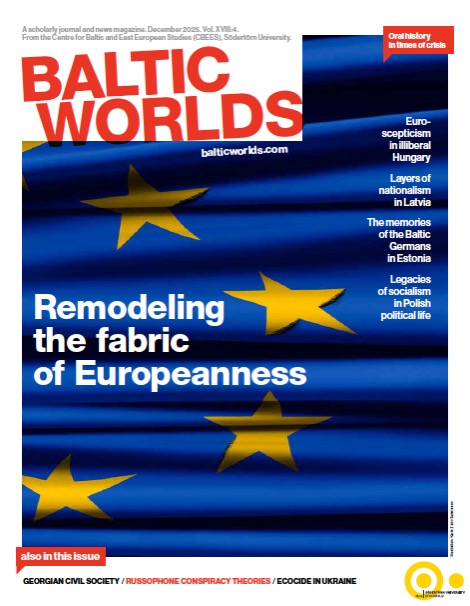 Issue 2025, 4:
  Baltic Worlds covers; the Baltic Sea Region, Eastern Europe, Russia, CentralAsia, Caucasus and the Balkan area.