contributors

Jonas Harvard

Manager for the Nordic Spaces programme, Centre for Baltic and East European Studies, Södertörn University. Research fellow at the Department of Humanities, Mid Sweden University. Leader of the Distant News and Local Opinion project.

Finished his PhD thesis, which dealt with the history of the concept Public opinion, at Umeå University in 2006.

view all contributors

Articles by Jonas Harvard

  1. Introduction Chornobyl in the fog of war 40 years after the disaster

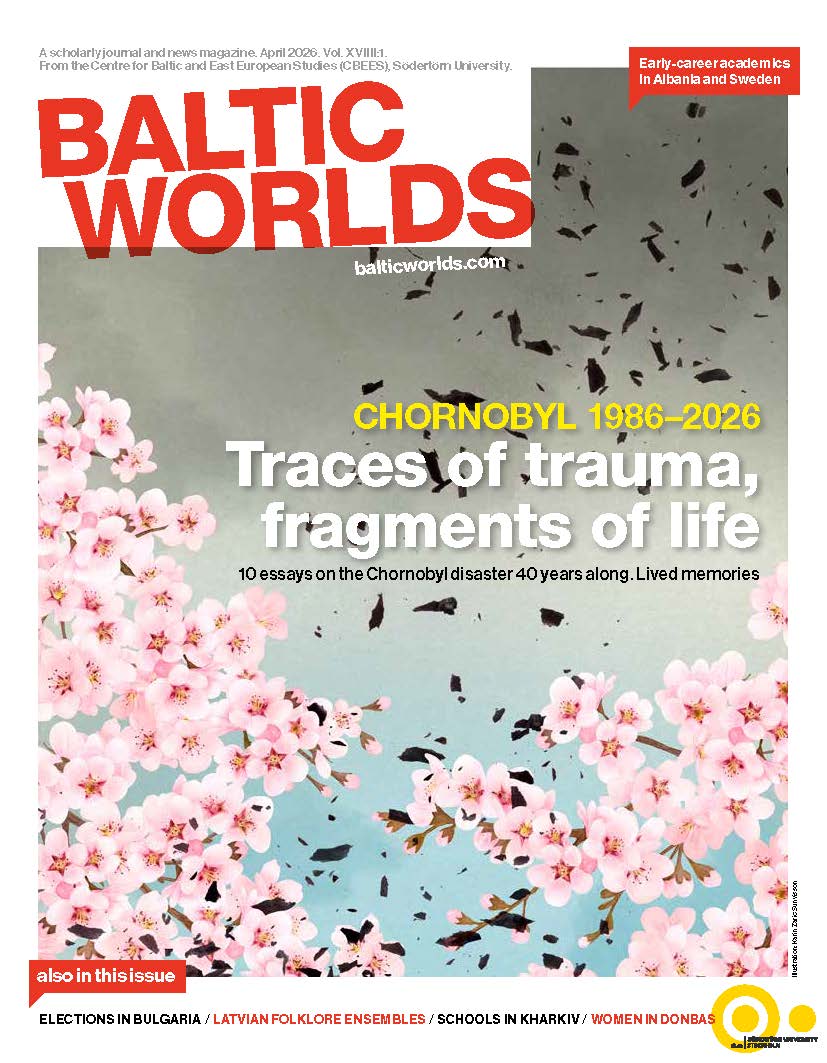
    The following essays in this theme-issue aim to capture a snapshot of that 40th anniversary amidst the ongoing war. These essays were written by researchers in life sciences, humanities and social sciences, as well as practitioners of the arts, many of whom have worked on Chornobyl issues in Ukraine, in Eastern and Western Europe and in North America for some time. They engage the effort to understand the impact of the ongoing violence unleashed by Russian troops on the legacy and memory of Chornobyl writ large. These impressions have been laid out in multiple, layered visions and memories of Chornobyl: Chornobyl as a symbol of technological failure, a reminder of local and national tragedy and resilience, and a place for international technoscientific and humanitarian cooperation and collective reflection about nuclear and other technogenic risks.

  2. CHORNOBYL IN THE WAR ZONE

    The first news from Chornobyl was about gunfire near the Buriakivka radioactive waste storage facility. By noon there were images: Russian tanks near the Administrative Building No. 1 of the plant. Denys Vyshnevskyi, the Head of Department at Chornobyl Radiation and Ecological Biosphere Reserve writes here about the occupation and how life changed in the Exclusion Zone. For many research groups, 2022 became the year of accepting a bitter truth – Chornobyl research was being suspended indefinitely.

  3. What we wouldn’t know without Chornobyl The important work of scientists in the Exclusion Zone

    From the moment of its establishment, the Chornobyl Exclusion Zone (CEZ) became a territory separated from the rest of the country: governed by different rules and a distinct internal logic. The isolation of the CEZ and the urgency of its tasks have shaped – and continue to shape – specific demands on the scientists who work there. Chornobyl science is also influenced by crises that have repeatedly redefined its priorities.

  4. ATOMS FOR PEACE AND ATOMS FOR WAR IN UKRAINE’S NUCLEAR HISTORY

    Forty years after the Chornobyl disaster, the essay reflects on the impact of peaceful and weaponized nuclear energy in Ukraine’s history. One of the leading nuclear energy operators in the world, Ukraine suffered the worst nuclear accident in history, which had wide-ranging geopolitical consequences. One of them was to influence Ukraine’s decision to surrender the nuclear weapons inherited from the USSR, a decision that ultimately exposed. Ukraine to Russian predation. After its full-scale invasion of Ukraine in 2022, Moscow proceeded to create and manipulate unprecedented nuclear dangers for Ukraine’s civilian nuclear infrastructure, blurring – as it once did in Chornobyl – the distinction between atoms for peace and atoms for war.

  5. The zone of memory

    This article explores the transformation of the Chornobyl Exclusion Zone into a contemporary “zone of memory” shaped by physical inaccessibility and digital mediation. Drawing on memory studies and cultural heritage research, it analyzes how virtual tourism, social media, and virtual reality (VR) technologies influence the ways in which the catastrophe is remembered and experienced. Special attention is given to the role of immersive media, particularly VR applications, in producing affective and experiential forms of memory that differ from traditional narrative remembrance. The study argues that digital environments reorganize temporal perception and enable users to encounter the past as a sensory and emotional event, generating what may be described as immersive memory.

  6. Remembering Vilcha A twice abandoned villa

    This essay examines the fate of Vilcha, a village that was forcibly abandoned twice within a single generation. Originally located in Polissia, the village was evacuated after the Chornobyl disaster. Its inhabitants were resettled to a newly built village in the Kharkiv region. This second village of Vilcha was occupied and subsequently destroyed during the Russian-Ukrainian war. Based on three waves of oral interviews conducted between 2016 and 2025, this essay explores the experiences of forced displacement, memory, and loss. Vilcha emerges as a poignant example of repeated forced migration caused by both technological disaster and war.

  7. “This is how I dreamed of the fourth reactor” Maria Prymachenko and (not) naive images of Chornobyl

    Art in the Soviet Union was the mirror of the official communist party policy. However, Maria Prymachenko was successfully hiding the critique of the system behind “naive” pictures. She was one of the few artists who truly depicted the consequences of the Chornobyl catastrophe: from environmental issues to commemorating the dead, from illnesses to corruption surrounding liquidator certificates.

  8. Writing the disaster from Hiroshima to Chornobyl ATOMIC AND NUCLEAR TESTIMONIES AND THE AFTERLIFE OF DISASTERS

    This essay examines the memorialization of two pivotal nuclear catastrophes – the atomic bombing of Hiroshima in 1945 and the Chornobyl nuclear disaster in 1986 – through the lens of testimonial writings and Maurice Blanchot’s concept of “the disaster.” Drawing on Japanese hibakusha testimonies and Chornobyl survivors’ accounts, the essay contrasts political memory, which seeks closure and national integration, with cultural memory, which preserves trauma, ambiguity, and unresolved loss. Testimonial writings, rather than commemorating a concluded past, emerge from within the disaster itself, articulating a reality that defies assimilation into redemptive historical narratives.

  9. Peaceful atom, haunted legacy. ECHOES OF WAR(S) IN CHORNOBYL DOCUMENTARIES

    From a cinematic perspective, the Chornobyl accident became one of the most generative episodes in Ukrainian film history. The explosion of Reactor No. 4 triggered an unprecedented surge in film production: between 1986 and 1998, around forty documentaries were produced, alongside only one feature film. This essay examines one of the earliest attempts to represent the disaster, Volodymyr Shevchenko’s Chornobyl. Chronicle of the Hard Weeks (1987), now regarded as a key Chornobyl film. Focusing on its pervasive militarized rhetoric, the essay investigates how wartime language and memory structure the film’s interpretation of what was fundamentally a civilian, technological catastrophe.

  10. Chornobyl Children A generation between two realities

    After the collapse of the USSR, rural Belarus faced severe economic and social crises and psychological issues. International humanitarian Chornobyl Children respite programs enabled hundreds of thousands of children to spend time abroad in Europe and North America. Although designed to improve health after the 1986 disaster, these initiatives gave encounters with other ways of living and thinking. Personal testimonies and long-term observations suggest that the experience significantly influenced the youth’s aspirations, self-perception, and life trajectories. These projects became a transformative encounter with a bigger world.

Looking for someone? Enter a contributor's name and we will have a look!

Here you can read about the people who have been involved in Baltic Worlds. The texts and images have been provided by the individuals themselves.

If you have contributed to Baltic Worlds and would like to update your presentation, or if you want to send a message to one of our collaborators, send an email to bw.editor@sh.se.