The protestors and officials in Belarus use different national flags. Why is the massive state-run propaganda against peaceful protests focusing on the white-red-white flag and the history of World War II? Referring to the white-red-white flag the official propaganda described the leaders of opposition as inheritors of the pro-Nazi collaborators. The fact that under this flag Belarus proclaimed its independence in 1918 and again in 1991 has been muted. In a study of political symbols of Belarus the author contributes to a more detailed understanding of the ongoing situation in the country.
By
Andrej Kotljarchuk
September 14, 2020
In this article, we compare the differing responses of the five Central Asian republics to Covid-19. We pay particular attention to how the virus presents opportunities to strengthen authoritarian rule within the region: for authoritarian regimes, the virus offers an opportunity to suppress dissent and strengthen authoritarian norms. While authoritarian states have recognised the spread of the virus in order to receive international humanitarian assistance, they have hidden the true number of infected and victims of the disease, as well as forbidding doctors to talk about the dangerous working conditions in hospitals, and imprisoning citizens for spreading false information.
By
Edward Lemon and Oleg Antonov
June 21, 2020
The period of pandemic demonstrated the main problem which affected dynamic of statistics and overall situation in the country – a lack of trust of citizens in the state institutions, adding to their already undermined fabric by many years of exclusive policies of the self-interest driven elite. The pandemic situation could have served as an excuse for solidarity and mobilization of the society vis-a-vis common threat. Instead it was used by the government to strengthen its power.
By
Leila Alieva
June 17, 2020
As the citizens in this time of crisis have found they have to take responsibility for their own and others wellbeing the social contract could potentially be considered broken, or at least breaking. Perhaps this in fact the reason the Belarusian authorities have found themselves faced with a unique volatile situation as the general frustration over how they handled the Covid-19 situation is spilling over to the ongoing presidential election campaign.
By
Sofie Bedford
June 16, 2020
As Poland lifts restrictions and comes out of the lockdown ensued by COVID-19, much has been said on what the pandemic has revealed about our economy, public institutions, gender relations, and state of democratic checks and balances. What has been less discussed, yet not gone unnoticed, is the way this security crisis has revealed ongoing processes of societal militarization, and the shift of society-military relations towards closer ties and interactions. Just like the war in Ukraine and the Refugee Crisis, Covid-19 has further normalized bringing the Polish society into defense through militarized channels. However, a closer look reveals the potential for shifting this process into more civilian-based forms.
By
Weronika Grzebalska
May 31, 2020
The Covid-19 pandemic created the need to find a new way for 100 Latvian MP’s to debate and pass laws without sitting side-by-side in their historical parliamentary hall. A new e-system now enables Latvian MP’s to perform their legislative functions from anywhere they have an Internet connection.
By
Ojars Eriks Kalnins
May 28, 2020
Argentina has experienced a wave of emerging feminism in recent years. Feminist organizations seems to be appearing everywhere.
By
Jenny Ingridsdotter
May 25, 2020
In this issue (2020:1), there are several examples of scholars investigating contemporary feminist mass-struggles from this point of view, asking whether these are examples of or have the potential for forming a feminist populist movement that can effectively counteract neoliberal and authoritarian regimes.
By
Jenny Gunnarsson Payne
May 24, 2020
The contributions to this issue (2020: 1) of Baltic Worlds aptly show that in country after country the representatives of the right-wing parties join ultraconservative groups and religious authorities in attempts to limit women’s reproductive rights, undermine the legitimacy of gender studies as a field of scientific inquiry, and viciously attack sexual or ethnic minorities.
By
Elzbieta Korolczuk
May 24, 2020
We can all agree that this pandemic is hard to manage and that the saving citizens’ life is the most important issue to deal with initially, but let us reflect on the consequences of the responses. The pandemic experience and the lockdown in Albania, among other perspectives, can be analysed by answering two main questions: 1. What is the socio-economic cost of the lockdown for almost 3 months? 2. What are the implications for the democratic system, is the freedom challenged?
By
Gilda Hoxha
May 18, 2020

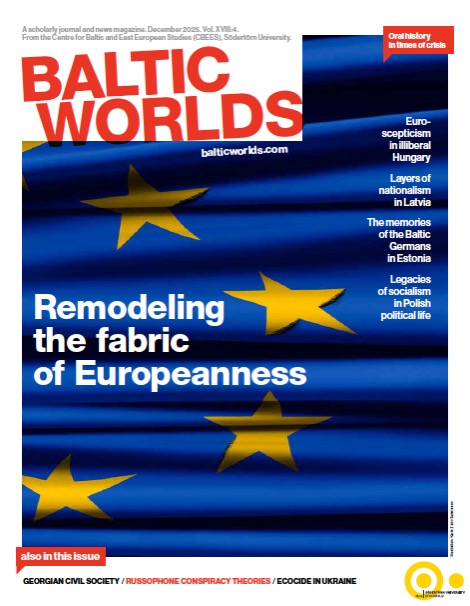 Issue 2025, 4:
  Baltic Worlds covers; the Baltic Sea Region, Eastern Europe, Russia, CentralAsia, Caucasus and the Balkan area.