In Communist Poland, women had the right to abortion on request since 1956, while in Sweden, access to abortion was limited. The ”Polish solution” received ample attention in Swedish media.
In the 2000’s, Polish abortion policies were once again referred to as a reason for changing the Swedish abortion law, but the situation was now a very different one.
By
Lena Lennerhed
April 9, 2016
Mass mobilization against the ban on abortion is just another example of a new wave of grassroots mobilization in citizens protesting against the changes introduced by the conservative populist Law and Justice in Poland. Polish society becomes extremely polarized but also much more engaged and politically active.
By
Elzbieta Korolczuk
April 5, 2016
It’s not always that the departure of someone whom we have a professional relationship with leaves a physical sense […]
By
Charlotte Bydler
November 19, 2015
Robert Conquest died on Monday 3 August in Stanford, California. He was 98. Lennart Samuelson here writes on a historian who in his fundamental book of 1969 more than any other coined the term ‘the Great Terror’ for Stalin’s purges and show trials in the 1930s. Baltic Worlds also here highlight Samuelson’s previously published review on the Festschrift Political Violence: Belief, Behavior, and Legitimation, presented to Robert Conquest on his 90th birthday.
By
Lennart Samuelson
August 21, 2015
In Ukraine today, “solidarity” means self-dedication and sacrifice — and is more tangible than ever before.
By
Kateryna Mishchenko
May 19, 2015
To speak of a solidarity beyond sense or meaning does not imply that the solidarity in question lies beyond the world, or beyond existence. What Patočka is trying to come to terms with is rather a solidarity at the limits of existence and at the limits of experience: the experiences of the limits of existence.
By
Gustav Strandberg
May 19, 2015
The term “fraternity” has been clearly linked to a register that could be called romantic. This explains the desire to distinguish the word from others like “solidarity” and “justice” and in particular “equality”.
By
Jean-Luc Nancy
May 19, 2015
In 1980, women’s participation in the Solidarność movement was far from invisible. Women were present from the start and they “took over” several highly important activities in Solidarność after its de-legalization in December 1981. The invisibility of these tasks was compounded by the fact that all of this work was illegal.
By
Ewa Majewska
May 19, 2015
The author analyzes the content of the word “solidarity”, not for the sake of linguistics, but in the belief that words contain memories as well as many other experiences, often conflicting ones. He also talks about Solidarity, the trade union in Poland, which was created in August 1980 and crushed in December 1981.
By
Leonard Neuger
May 19, 2015
Ludger Hagedorn has gathered together different voices, all adding insights into the meaning of solidarity. Here he presents the different contributions and place them in a wider context. He concludes, "Perhaps the outcome of solidarity counts less than the atmosphere that it creates and in which it unfolds its explosive message.".
By
Ludger Hagedorn
May 19, 2015

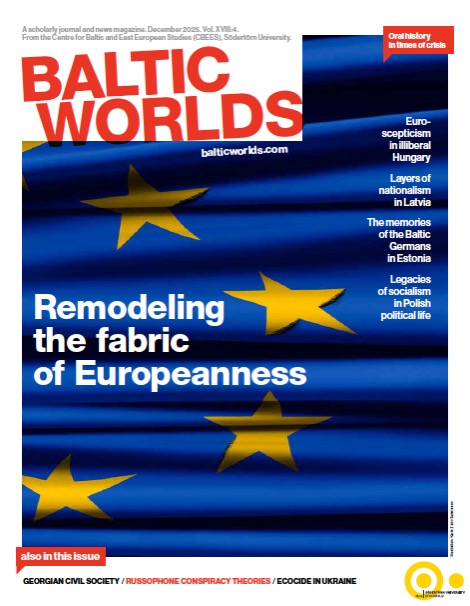 Issue 2025, 4:
  Baltic Worlds covers; the Baltic Sea Region, Eastern Europe, Russia, CentralAsia, Caucasus and the Balkan area.