Aleksanteri Annual Conference 2016 LIFE & DEATH IN RUSSIA
The Russian welfare state has undergone deep structural transformations during the last twenty-five years. The aim of the 16th Annual […]

A scholarly journal from the Centre for Baltic and East European Studies (CBEES) Södertörn University, Stockholm.
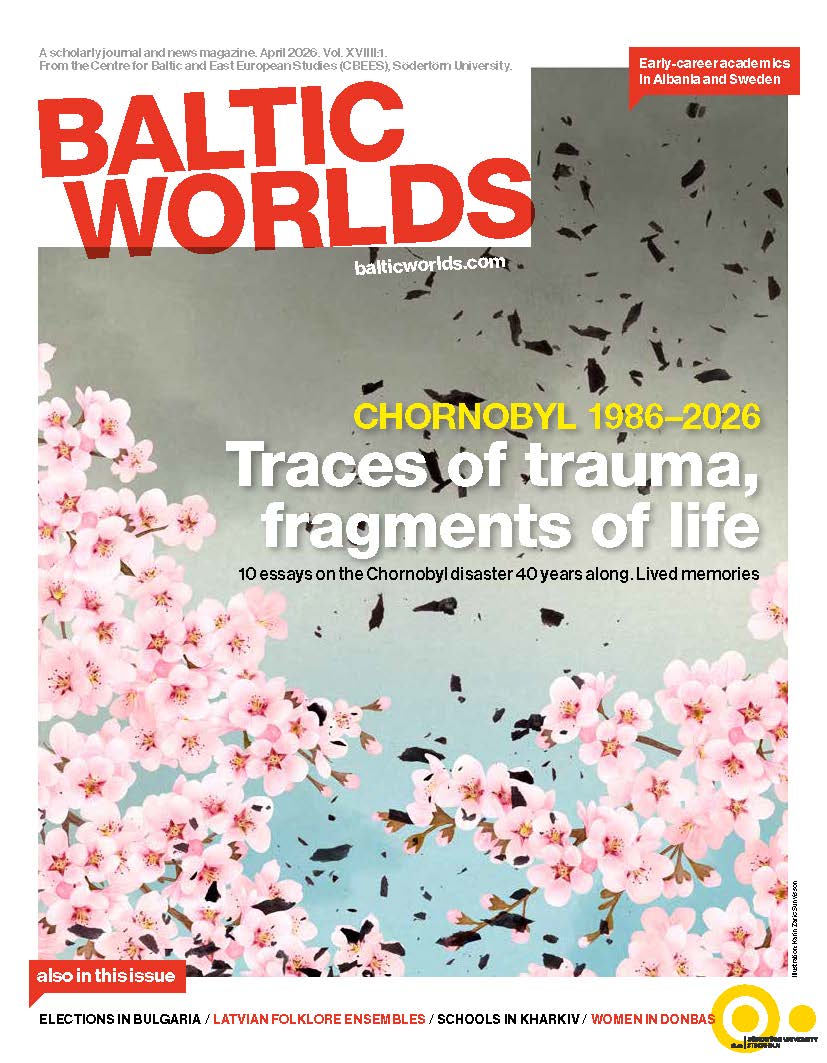 Issue 2026, 1: Download.
191 articles tagged with russia were found.
The Russian welfare state has undergone deep structural transformations during the last twenty-five years. The aim of the 16th Annual […]
Although agencies involved in drug control and regulation are important for the reproduction of differentiated practices of drug use, they formulate a rather homogeneous image of a drug user as an unhealthy deviant and criminal, and an unequivocal threat to society. In the process of policy realization, the most vulnerable groups of users become the main target of public intervention. As a result, stigmatization and violence against these groups becomes institutionalized and legitimized.
Disinformation tools are not something unique or new and have been used long time ago. But now we are living in times when information became a weapon. Annexation of Crimea, war in Donbas and in Syria have shown a significant role of information.
Kalle Kniivilä, Sovjets barnbarn: Ryssarna i Baltikum. [The grandchildren of the Soviet Union: The Russians in the Baltic states] Atlas 2016. 320 pages
Viacheslav Morozov, Russia’s Postcolonial Identity: A Subaltern Empire in a Eurocentric World. New York, and Basingstoke: Palgrave Macmillan, 2015, viii + 209 pages
Policy-making is an applied process. We can ask: towards what end or goal are policy-makers striving? At present, as far as domestic and increasingly foreign policy-making in Russia are concerned, an important policy direction can be described with reference to development.
The practice of mandatory recourse to linguistic experts’ opinions in cases pertaining to racial, ethnic, and other types of hatred and hostility, has caused the vast development of different approaches to the analysis of the texts. During last ten years, numerous methods for identifying “verbal extremism” have been recommended. It has been suggested that the evolution of Russian legal linguistics has not yet resulted in a “common theoretical basis for linguistic investigation in court that is shared by all experts”. The current status of the proposed approach to studying texts in order to identify “hostility and hate” demonstrates both the difficulty of establishing a general theoretical basis for forensic linguistics as a whole and the contradictions that arise in applying the numerous methodologies that exist in Russian science for studying “extremist” texts.
The outcome of the 2016 Duma elections further consolidates the Russian authoritarian system. The changes in the electoral legislation resulting in the reintroduction of the mixed voting system could, in theory, have helped open up the system to other parties. This did not prove to be the case, however, as it instead favoured Putin’s current constellation of power.
Lena Jonson, Art and Protest in Putin’s Russia. London and New York: Routledge 2015, 399 pages.
The case of late Soviet and early post-Soviet squatting helps to elucidate how squatting is structured in regard to public-private relations and what the political component of squatting can be in a society not based on private property. The self-help occupying of vacant flats was not restricted to subcultures.
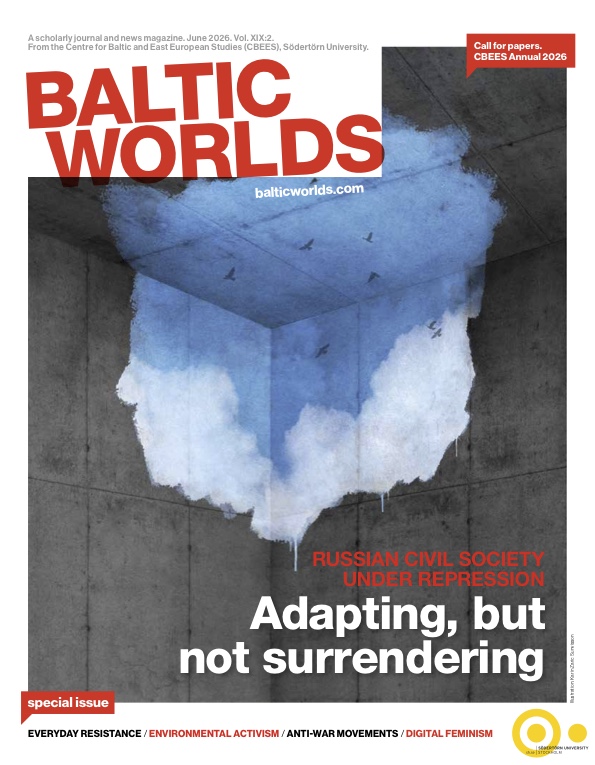 Issue 2026, 2: Download.
 Baltic Worlds covers; the Baltic Sea Region, Eastern Europe, Russia, CentralAsia, Caucasus and the Balkan area.