190 articles tagged with russia were found.
Whether comic, violent, brutal, or burlesque, Bakhtin’s explorations of cultural communication today appeal to linguists and literary theorists; but also to artists, musicians, and scholars in education, Slavic languages, postcolonial studies, and many other fields.
By
Charlotte Bydler
October 9, 2014
The purpose of the conference was to establish new points of contact between the actively developing traditional Bakhtin studies (in literature, language, and cultural theory), on the one hand, and those new directions in research that have discovered the importance of Bakhtin’s ideas in new applications in the humanities, social sciences, education, artistic research, and art practices.
By
Irina Sandomirskaja
October 9, 2014
Many postcommunist countries have large numbers of stray dogs. In several localitites in Russia poisoned meat has been put out to keep the number of strays down. Before major events, such as the Winter olympics in Sochi, mass culling has been announced. Dog rights activists rather suggest sterilization programs and animal shelters.
By
Ninna Mörner
April 30, 2014
Huntington’s theory is more relevant now than ever in Russian discourse. The background for this is the growing religious awareness among Muslims and the growth of Russian nationalism, which fills the void left after the collapse of communism; the strengthening of the Orthodox Church; and President Putin’s recent anti-West campaign.
By
Ingmar Oldberg
April 30, 2014
The shift from a primary focus on Shalamov’s prose to a more comprehensive approach which includes his poetic, biographic, and dramatic works informed the conference throughout its three days.
By
Josefina Lundblad-Janjić
April 30, 2014
The only functioning system for transactions in the Soviet Union was in fact blat, the system of corruption and tacit agreement and alliances among all parties involved in a given transaction, is here argued. The “knowing smile” was a shared signal for those in the system.
By
Alena Ledeneva
April 29, 2014
Irina Sandomirskaja, professor of cultural studies at CBEES, Södertörn University, was awarded the most prestigious Russian prize for literary scholarship, […]
By
Irina Sandomirskaja
April 16, 2014
Fatherhood in Russia today is a vague institution. The role of the father is developing in several directions at the same time, both in state policies and in the private sphere. The lack of coherence is somewhat surprising since active, engaged fatherhood has proven to be an important factor to reverse declining birth rates, which is a key factor behind Russia's current demographic crisis.
By
Johnny Rodin & Pelle Åberg
January 23, 2014
The 13th Annual Aleksanteri Conference “Russia and the World”, which took place in the main building of the University of Helsinki, October 23–25, was dedicated first and foremost to Russian foreign policy.
By
Irina Kotkina
January 21, 2014
The wish to ethnically classify everything found in the Viking Age trading locations has led archaeologists to neglect the fact that material in those ethnic categories displays not only similarities but also frequent variations, argues the author. She calls for acknowledgment of the differences and variations within those presupposed ethnic categories.
By
Lina Håkansdotter
November 7, 2013

 Issue 2026, 1:
 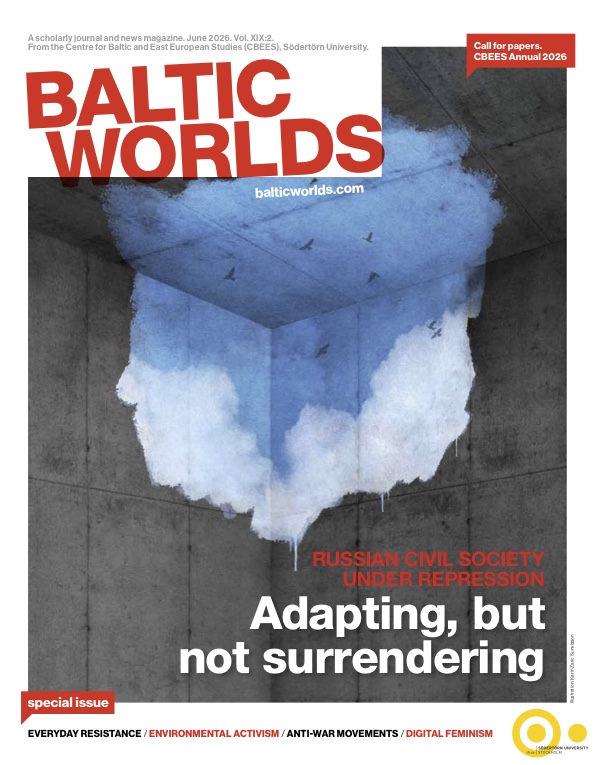 Issue 2026, 2:
  Baltic Worlds covers; the Baltic Sea Region, Eastern Europe, Russia, CentralAsia, Caucasus and the Balkan area.