This article examines the construction of Narva and local spatial identity formation from the perspective of Russian-speaking Estonians in Narva, as elucidated in their own discourses and perceptions.
By
David J. Trimbach
June 23, 2016
Katerina Smetanina, Når Ivar møter Ivan. Å gjøre forretninger i Russland [When Ivar meets Ivan. How to do business in Russia] Oslo: Arneberg Forlag, 2014, 548 pages.
By
Helene Carlbäck
November 19, 2015
Tsuneo Akaha and Anna Vassilieva (ed.), Russia and East Asia. Informal and Gradual Integration, London and
New York: Routledge 2014, 320 pages.
By
Irina Korgun
November 19, 2015
The paper examines the relationship between the degree of the integration of financial regulation and the level of economic development. The main finding is that factors such as population and economy size have negative effects on financial regulation integration, while quality of governance, the size of the non-banking financial market sector and regulatory quality have a positive impact.
By
Maria Chernova and Alexander Abramov and Alexander Radygin
November 19, 2015
The “non-reform agenda” since the mid-2000s means that for many years, the economy has been sliding due to structural problems and weak institutions. Since 2014 the additional problems of geopolitical tension, low oil prices and economic sanctions have resulted in the economy contracting. Despite the depressed economy the leadership keeps military expenditure at a high level.
By
Susanne Oxenstierna
November 19, 2015
The article addresses the issue of the business climate in Russia from the Swedish investors’ perspective and relates it to a general theoretical debate in the field. Statistical test suggests that the majority of variables relating to the business climate has deteriorated between 2012 and 2014.
By
Olga Golubeva
November 19, 2015
The study is based on qualitative interviews in small towns and villages in four Russian regions. Actions by local inhabitants, organizations and local administrations are studied. The relation between agency and local development is discussed.
By
Leo Granberg and Ann-Mari Sätre
November 19, 2015
"Business is not particulary concerned with democratic values, but rather with the existence of stable rules of the game and secured property rights for investors, says professor Andrei Yakovlev, head of the Institute for Industrial and Market Studies at the higher School of Economics in Moscow.
By
Ilja Viktorov
November 19, 2015
At a symposium in March 2015, Erasmus University Rotterdam, Andrej Kotljarchuk presented the results of an ongoing research project “The Roma Genocide in Ukraine 1941-1944: History, memories and representations”.
By
Andrej Kotljarchuk
May 28, 2015
The unsuccessful “translation” of “gender equality” into Russian reveals numerous difficulties and indicates that the realization of the transnational feminist agenda could meet with serious obstacles not only in the countries of the “Third World”, but also in some former “Second World” countries.
Essay by
Yulia Gradskova
May 12, 2015

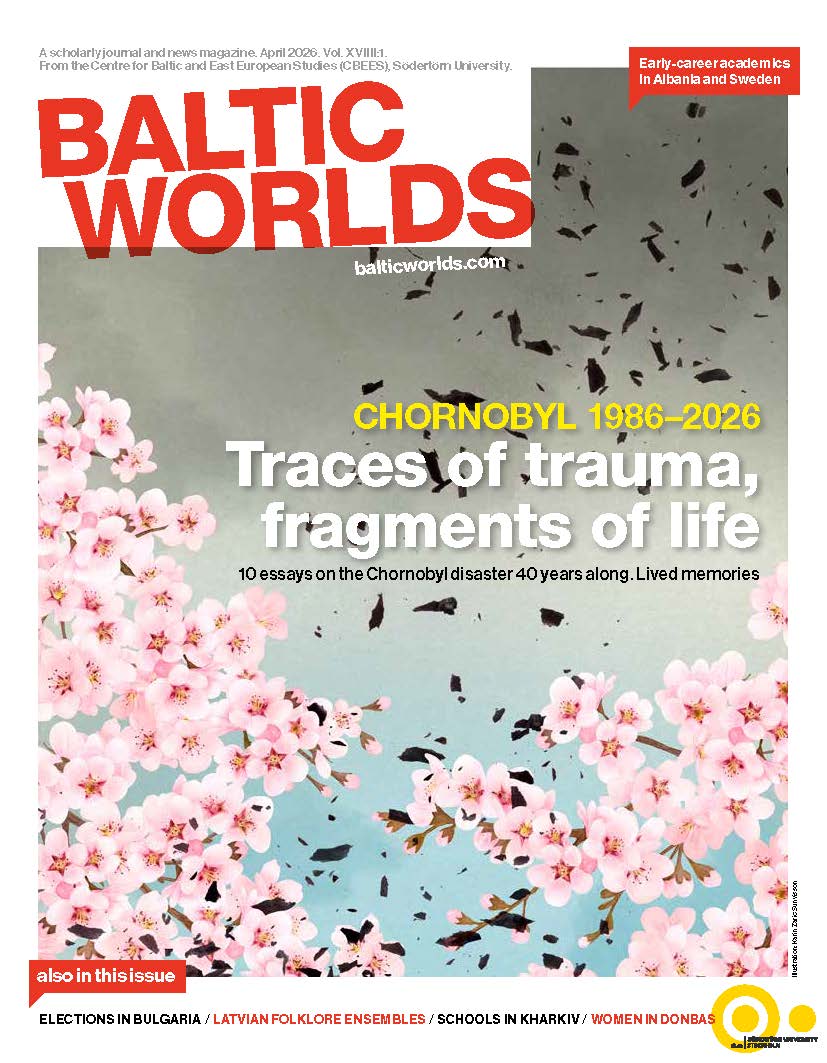 Issue 2026, 1:
 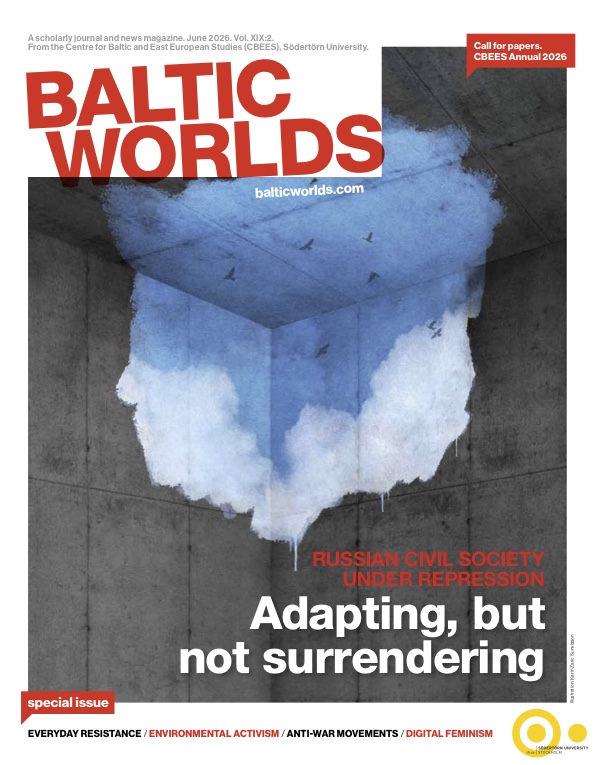 Issue 2026, 2:
  Baltic Worlds covers; the Baltic Sea Region, Eastern Europe, Russia, CentralAsia, Caucasus and the Balkan area.