The Russian energy strategy for the next few years includes lofty goals. While other countries are investing 1.5 percent of their GDP in the energy sector, Russia is spending 5 percent. This was noted at the Norwegian Institute of International Affairs (NUPI) Annual Conference on Russian and Eurasian Studies.
By
Ninna Mörner
January 10, 2011
Professor Archie Brown argues that Gorbachev was not selected as General Secretary because he was a reformer. He did at the time he became party leader believe both that the system was reformable and that it must be reformed. But he did not, however, reveal the full extent of his existing reformism on the eve of perestroika.
Essay by
Archie Brown
August 25, 2010
A close reading of Ginzburg’s diaries shows how a fight against a shrinking living space is conducted on two levels: the purely physical fight for survival during the famine in Leningrad and the intellectual fight in a cultural environment increasingly dictated.
Essay by
Irina Sandomirskaja
August 1, 2010
The development of a system for producing Russian fashion clothing, along with the discussion surrounding this venture into fashion, is described here. The GUM department store established a studio and hired designers. The quality and wealth of ideas was often poor, but demand grew steadily.
Essay by
Sergey Zhuravlev & Jukka Gronow
July 1, 2010
A close reading of Zinoviev and his view of the dissolution of the Soviet Union as a tragedy. Zinoviev helps us to understand how it feels to have your world dismantled and how that experience forms many of the attitudes that lie behind Putin’s policies.
Essay by
Philip Hanson
July 1, 2010
Factors such as widespread ennui and resignation should also be seen as part of the explanation for the dissolution of the Soviet Union. The increasing tristesse, combined with a diminishing fear of reprisals, contributed to the collapse of the system, it is here claimed.
Essay by
Gudrun Persson
July 1, 2010
Illegal logging is the foremost threat to the survival of forests around the world. It also means that many countries lose vast amounts of tax revenue and custom duties. Russia and the Baltic countries account for the largest volume of illegal export to the EU countries.
By
Anders Hellner
July 1, 2010
Russia Lost or Found? Patterns and Trajectories Edited by Hiski Haukkala and Sinikukka Saari Helsinki: Ministry of Foreign Affairs & Edita 2009 217 pages
By
Lena Jonson
July 1, 2010
+ Michail Kasianov, Bez Putina: Politicheskiye dialogi s Yevgenyem Kiselyovym, [Without Putin: Political Dialogues with Yevgeny Kiselyov] Moscow: Novaya gazeta 2009, 320 pages
By
Ilja Viktorov
March 24, 2010
Södertörn University held a conference on the legacies of 1989, “Recasting the Peaceful Revolution”. The predominating
perspective during the entire conference: the fall of communism was the result of popular pressure and protest from below, not of great-power politics. Much was to be celebrated the automn of 2009.
By
Anders Mellbourn
February 24, 2010

 Issue 2026, 1:
 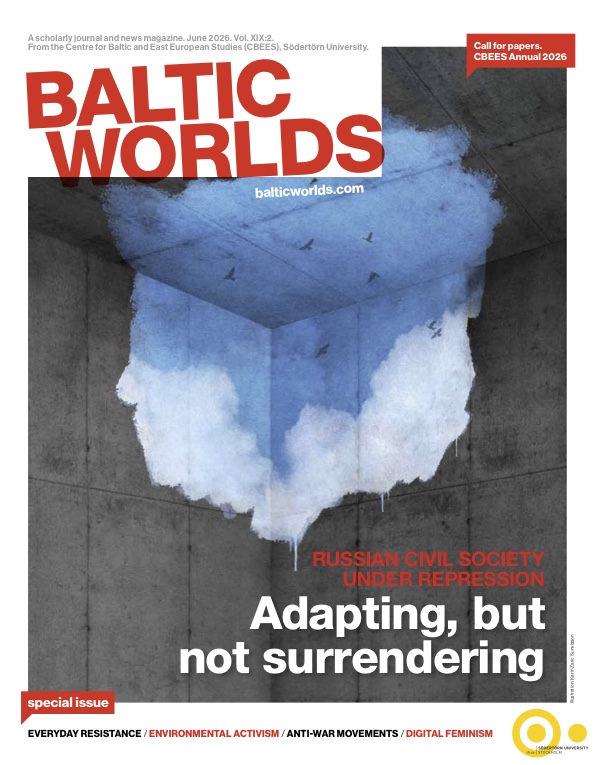 Issue 2026, 2:
  Baltic Worlds covers; the Baltic Sea Region, Eastern Europe, Russia, CentralAsia, Caucasus and the Balkan area.