The article considers the centrifugal trajectories of the postsocialist world in the direction of the secondary Europe and the global South as seen through the prism of gender relations and at the intersection of the postsocialist and the postcolonial. The author focuses on the importance and specificity of geopolitical positioning in postsocialist gendered discourses using Central Asia and the Caucasus as graphic examples.
Essay by
Madina Tlostanova
May 12, 2015
Two distinct cases of kin-state relations are examined: that of Russians living in states neighboring Russia and that of Magyars living in states around Hungary. The question of kin-state relations is put at the forefront of European minority issues.
By
Kjetil Duvold
May 12, 2015
In 1996, a Special Economic Zone was created that made it favorable for both Russian and foreign companies to relocate production to Kaliningrad. Once the intentions were to make Kaliningrad known for more than just its military bases. But this is no longer the case. Kaliningrad, once again, is gliding away from being an economic zone to becoming a military zone.
By
Påhl Ruin
January 21, 2015
“Translation in Russian Contexts: Transcultural, Translingual and Transdisciplinary Points of Departure”, hosted June 3–7 by the Uppsala Centre for Russian and Eurasian Studies (UCRS), brought together scholars and practitioners of translation from Europe, Russia, and North America to Sweden, a central point between Western Europe and Russia.
By
Sara Feldman
October 20, 2014
By analyzing the usage of the word “market” (rynok) in the Russian press since 1990, the author shows how the keyword takes on new meanings, reflecting and relates to the different social and political roles of the press outlets in an evolving, modernizing environment.
By
Katja Lehtisaari
October 20, 2014
The author argues that the equation of culture and natural resources has become a fundamental metaphor of the official patriotic discourse of identity in contemporary Russia. This conceptualization of the past frames nation building and state construction, the “nostalgic modernization”.
By
Ilya Kalinin
October 20, 2014
In an attempt to bring Russian articulations of Russian religiosity into a dialogue with the American sociologist Robert N. Bellah’s theory on secularization the author argues for a Russian model of civil religion.
By
Elina Kahla
October 20, 2014
Focusing on the role of the Soviet legacy the author conducts a detailed analysis of the restoration work, as well as the official discourse surrounding it. The aim is to uncovering the ideological ambiguities of Russia’s most recent top-down modernization, a modernization based on values claimed to be “conservative”.
By
Irina Kotkina
October 20, 2014
The Russian media system today is a hybrid composed of the main public sphere — that is, state-owned mainstream media — and a parallel public sphere or counter-sphere, consisting of mainstream media relatively disloyal to the Kremlin, and social media. The present study is based on an analysis of one hundred journalist’s blogs maintained on the LiveJournal platform in during the 2012 presidential election in Russia.
By
Elena Johansson
October 19, 2014
The nationally organized camp Seliger All-Russia Youth Forum gathers tens of thousands of young Russians every year. Here a report from the inside of the camp, observations in contemporary nation-building.
By
Kristiina Silvan
October 18, 2014

 Issue 2026, 1:
 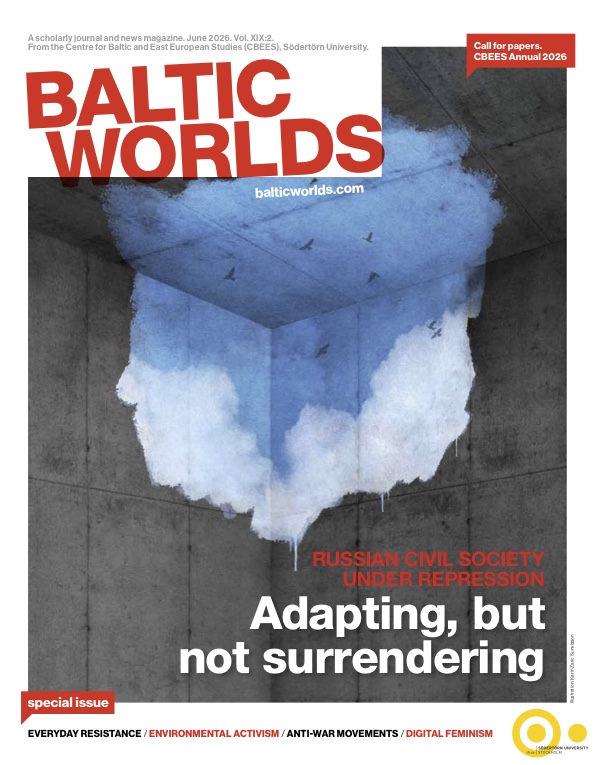 Issue 2026, 2:
  Baltic Worlds covers; the Baltic Sea Region, Eastern Europe, Russia, CentralAsia, Caucasus and the Balkan area.