190 articles tagged with russia were found.
The history and sociology of the telephone in Russian society have only slowly become the object of serious study. The scope of this essay is limited to the following two topics: first, the forms of use, in pre-revolutionary Russia and the Soviet Union, of the telephone as a means of communication, potentially universally available and “horizontal” but actually restricted by “vertical” forces; and second, the symbolism that accumulated around this means of communication in Russian and Soviet culture.
By
Lars Kleberg
April 10, 2012
Interviews from three communities in a Russian region illustrate that there are many new opportunities for potential women entrepreneurs, while there are also many at times unpredictable obstacles to overcome.
Essay by
Ann-Mari Sätre
April 10, 2012
It’s hard to say whether the revival of icons is the outcome of rising religiosity in general, a growing need to manifest one’s faith, or simply the search for some kind of salvation in a time of political and economic uncertainty. Nancy Westman went to St. Petersburg for a closer study of modern iconography; she also spoke to a couple of Swedish iconographers.
By
Nancy Westman
April 10, 2012
The author has been following the protest against Putin through Facebook and a number of internet portals and claims that "even through the distance that any media technology always creates, one could not help feeling deeply affected by the joyous festivities during the protest events – tens of thousands strong manifestations, marches, flash mobs, and car rallies".
"The idea that a political change must precede an economic discussion prevails. In the absence of a social program, the carnival feature of the protest movement becomes the uniting principle pulling together people who otherwise would have never ever acted together.".
By
Irina Sandomirskaja
March 1, 2012
Next Sunday, on March 4, presidential elections are held in Russia. The likely winner of the elections, Vladimir Putin, has been known already for five months but during these five months Russian political climate has changed significantly.
By
Jukka Pietiläinen
March 1, 2012
Francis W. Wcislo, Tales of Imperial Russia, The Life and Times of Sergei Witte, 1849–1915, Oxford: Oxford University Press, 2011, 314 pages
By
Anders Björnsson
January 18, 2012
Mark Bassin, Christopher Ely & Melissa K. Stockdale (eds.) Space, Place, and Power in Modern Russia, Essays in the New Spatial History, DeKalb, Northern Illinois University Press, 2010, 268 pages
By
Karl Schlögel
January 18, 2012
The fact that Moscow and St. Petersburg house in total five fashion events every season makes one think that the fashion business is considered attractive and economically sound in Russia. However, despite the growth of the Russian fashion market since the 1990s, the fashion industry is losing ground to other promising fashion hubs.
By
Ekaterina Kalinina
January 16, 2012
Infrastructure forms a link between the open global economic space and the non-public Russian political space. The question of how to manage the most important trade flows and understand their social importance is not, of course, solely seen as a matter of Russian politics. The research on Russia is also connected to the recent debate on the importance of increasing globalization and the mutual dependence of societies.
By
Katri Pynnöniemi
January 16, 2012
“Market Reform and Socio-Economic Change in Russia” was the subject of an ambitious full-day seminar held October 6, focusing on the period since the fall of the Soviet Union.
By
Per Jönsson
January 16, 2012

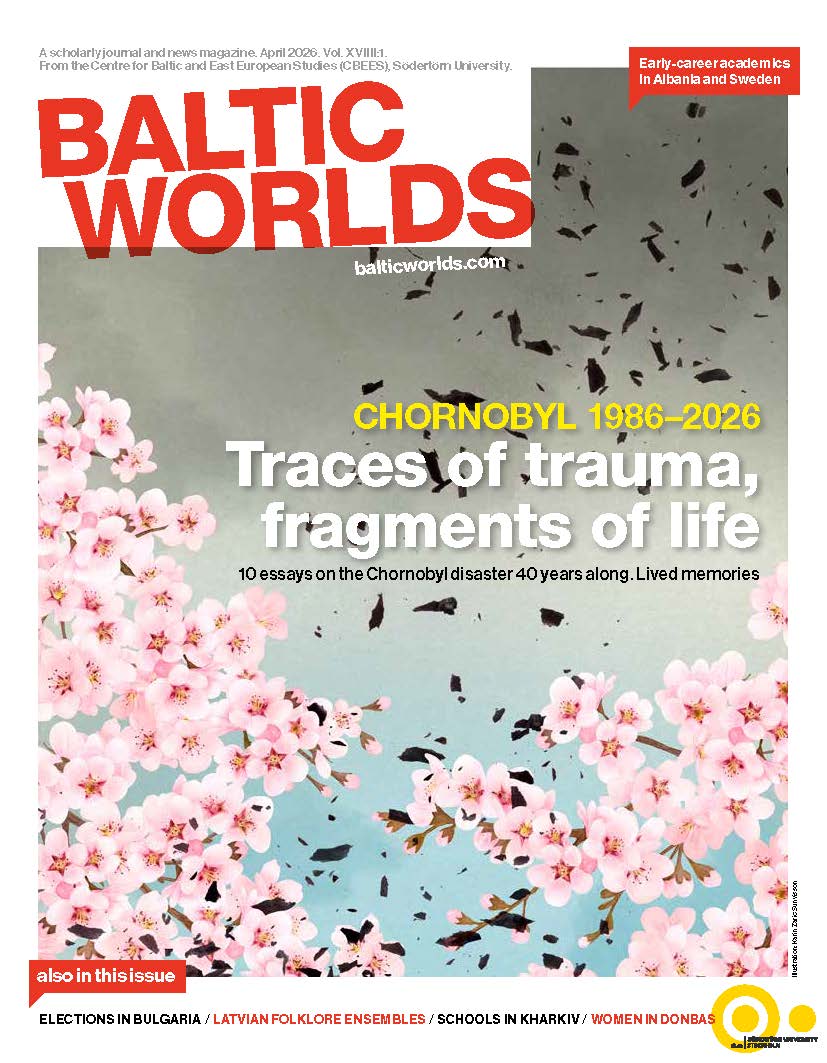 Issue 2026, 1:
 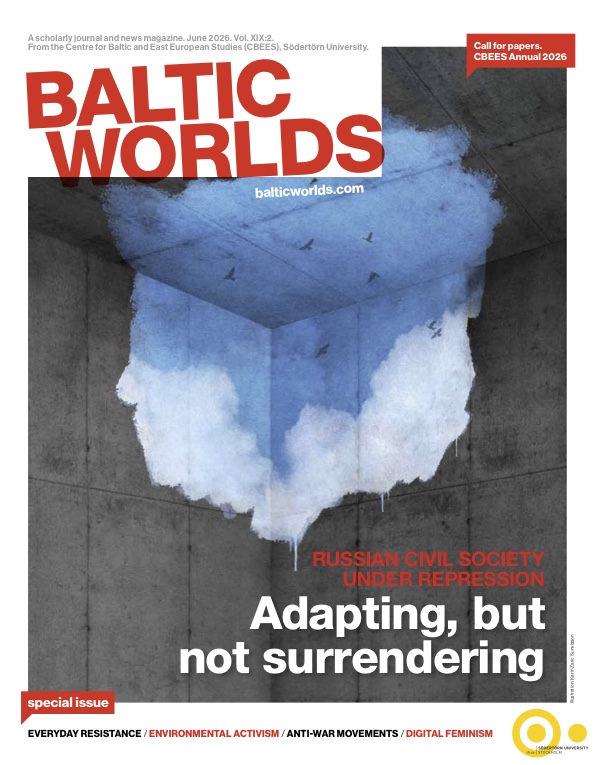 Issue 2026, 2:
  Baltic Worlds covers; the Baltic Sea Region, Eastern Europe, Russia, CentralAsia, Caucasus and the Balkan area.