Essays are selected scholarly articles published without prior peer-review process.
This year, HELCOM celebrates its 50th anniversary. Rüdiger Strempel, the Executive Secretary of HELCOM, is here presenting the close cooperation and alignment between HELCOM and the European Union in working against a backdrop of increasing environmental threats due to the triple planetary crisis of climate change, biodiversity loss and pollution on the one hand and geopolitical instability on the other hand.
By
Rüdiger Strempel
September 18, 2024
Drawing on in-depth interviews, this essay investigates professional strategies and researcher identity constructions in the precarious postdoctoral phase. The analysis indicates that most of the informants in the present study seem to be somewhere in the middle of the process of establishing a postdoctoral/early-career identity. The essay underlines the need for better preparing PhD students for the postdoctoral phase; and suggests that to most of the informants, the emerging researcher identities are secondary to more pressing issues, relating to survival in academia alltogether.
Essay by
Joakim Ekman
September 18, 2024
The formula “end of the Cold War” conveyed an erroneous idea. For centuries the relations between “East” and “West” were characterized by antagonism. In the 1990s determined attempts were undertaken to overcome the polarity. Western Europe and the US responded favorably to the desire of Central/Eastern Europe and of Russia to integrate themselves into Western institutions and organisms defined by democracy and market economy. However, the force of existing mental realities — such as the fear of Russia in Central/European states or Russia`s clinging to its imperialist past and failure to handle its economy and finances well – proved to be stronger than the idealistic intentions formed in 1989–90 on both sides of the divide.
Keywords: End of Cold War, “East and West”, 1990s.
Essay by
Tilo Schabert
September 18, 2024
In this paper, the AfD is examined in an attempt to understand the success of the populist party in the recent referendum on the European Union. It is a rhetorical analysis in that the election results are interpreted embedded in its rhetorical situation. Given this result, the success in the eastern parts of Germany has been attributed to the socialization of the GDR-era and the dashed hopes after reunification. It is a lack of confidence in this aspect of democracy that provides a breeding ground for parties like the AfD, which they know how to exploit through the use of alternative fora such as TikTok and Twitter on which they promote their ideas on new boundaries and alternative governance.
Essay by
Lisa Källström
June 19, 2024
The aim of the article is to examine what is called the “Polish Eastern policy”. This concept covers certain conceptual foundations on which subsequent governments in Warsaw have tried to build their relations with their neighbors from the post-Soviet area. The topic has already been widely described and discussed. Due to the limited volume of the article, this issue will be considered mainly in the context of the example of Polish-Ukrainian relations. The starting point will be a description of the circumstances in which Poland was the first country in the world to recognize the independence of Ukraine in 1991. Then, the motives of Polish decision-makers will be characterized. This applies both to 1991 and to the way they behaved during subsequent “Ukrainian crises.” For this purpose, Colin Flint’s concept of “geopolitical code” will be used.
Essay by
Michał Wawrzonek
April 23, 2024
This essay considers the myths surrounding the historical figure of Hetman Mazepa and their artistic expressions. More specifically, it compares and contrasts two recent stage versions of Pyotr Tchaikovsky’s Mazepa opera by theaters in Kharkiv in 2017 and Moscow in 2021, at the time of the Russian military operations on the territory of Ukraine. The desire of Ukrainian directors to return honors to the national hero is opposed by the Russian interpretation of the image of Mazepa as an archetype of a traitor. The essay shows how the Ukrainian version updated the plot and liberated the Mazepa myth from Russian and Soviet imperial distortions, thereby connecting the opera’s events with the contemporary struggle for a sovereign state. Meanwhile, underneath its modernist surface, the Russian version maintained the opera’s age-old metropolitan view of Ukraine as inferior.
Essay by
Liubov Kuplevatska
April 23, 2024
Alongside the private military company Wagner and his notorious Internet Research Agency (IRA), Yevgeny Prigozhin was associated with the Patriot Media Group (PMG) which amplified state narratives through its webpages and was registered by Roskomnadzor, the federal agency for supervision of Russian media. The Patriot Media Group was shut down after the mutiny, June 23, 2023, while most of its channels were removed or remain inactive currently. The essay provides a brief account of the Patriot Media Group’s structures, partnerships, and campaigns based on digital ethnographic observations of their web channels. The news coverage from predominantly Russian language news outlets sheds light on how the Group operated and what happened after Prigozhin’s mutiny. The essay concludes with some directions for future research on a complex and murky media production facility.
Essay by
Alexandra Brankova
April 23, 2024
The article considers the emergence of nationalisms during the period of the downfall of socialist regimes in Eastern Europe and concentrates on the formation of Slovene nationalism through the spyglass of historic narration. The Slovene case may provide some general lessons as to how, in national narrations, history is retroactively homogenized: all significant landmarks of Slovene history that now form the core of the narrative presented at the time the major breaks with the then standards of Slovene national identity.
Essay by
Mladen Dolar
December 11, 2023
In 1969 the Situationist group re-installed a copy of a statue of Charles Fourier on an empty plinth at Place Clichy in Paris as a gesture of commemoration of the events in May-June 1968 in Paris. The article will discuss the event and use it in an analysis of the ongoing monument wars that took off in the summer of 2020.
Essay by
Mikkel Bolt Rasmussen
December 11, 2023
This essay takes the novel The Museum of Unconditional Surrender by Dubravka Ugrešić as a starting point for a discussion of why the notion of a post-Yugoslav or post-communist cultural memory seems to be a contradiction in terms. The manifest impossibility of forming a collective post-Yugoslav memory provokes a reflection on how cultural and collective memory has been used in post-communist Eastern Europe to historify the communist past, which further has served the revival of a nationalist agenda. Ugrešić offers a counter memory, if we understand the term from Foucault as something that escapes the forming of identities. Finally, I suggest the notion of negative memory, as introduced by Reinhardt Koselleck, as a more apposite term for approaching memory in the post-communist sphere and in the unfolding catastrophes of the modern world.
Essay by
Tora Lane
December 11, 2023

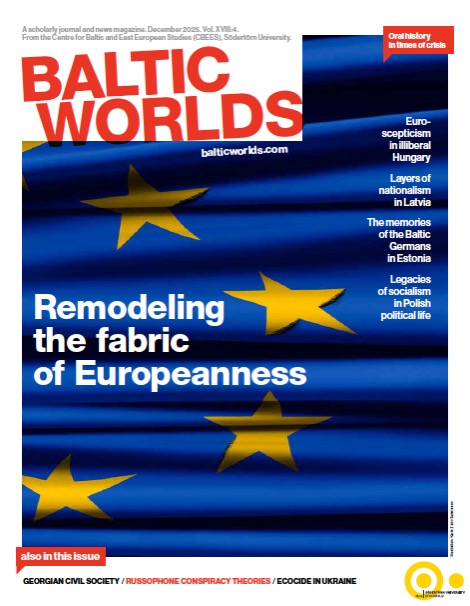 Issue 2025, 4:
  Baltic Worlds covers; the Baltic Sea Region, Eastern Europe, Russia, CentralAsia, Caucasus and the Balkan area.