46 articles tagged with estonia were found.
Views of the past are constantly being revised, with the impact of different political and social occurrences generating new narratives and ways of interpreting history. This essay focuses on three cases of recent spatial reconfiguration in Estonia, all demonstrating how contrasting memoryscapes are perceived, especially after the full-scale Russian invasion of Ukraine in 2022. Since then, the Soviet memorials, symbols and murals in public space in Estonia have fallen under intense scrutiny as remnants and symbols of the Soviet regime. Russian aggression towards Ukraine seemed to reopen the wound of the most recent trauma. At the same time, the legacies of more remote oppressors, the Baltic Germans, has taken on a new meaning as a more neutral and even positive heritage. With three examples of spatial transformation, the essay examines the choices made on treating the layers of Estonian history and raises questions about how current decisions could shape our perception in the future.
Essay by
Triin Reidla and Anu Soojärv
December 18, 2025
This article, based on longitudinal ethnography of Russophone groups in Estonia, examines conspiracy theories about the war in Ukraine as they emerged and evolved ever since the full-scale invasion. First, I explore the initial narratives and the underlying vulnerabilities driving conspiratorial thinking. I then discuss why these theories became taboo. Finally, I propose a novel approach to studying self-censored conspiracy theories – the metalevel analysis – and present preliminary findings from research on Russian-speaking adolescents in Estonia.
By
Anastasiya Astapova
December 18, 2025
This is a presentation of three original public opinion surveys covering the Baltic states, that were recently released in the public domain. All three surveys have been designed specifically to tap the political culture of Estonia, Latvia and Lithuania, including the Russian-speaking poulation groups and other domestic ethnic minorities.
By
Joakim Ekman
August 7, 2024
Since January 1, 2024, same-sex marriage is legal in Estonia, making it the first ex-Soviet, second post-socialist (after Slovenia) and 20th overall country in Europe to establish marriage equality. According to the law, marriages are contracted by two adults, including same-sex couples, who also have a right to jointly adopt children.
The law is an outcome of two decades of public controversy and political divide.
By
Alar Kilp
April 23, 2024
The material landscape of the Baltic states has dramatically changed with the start of the full-scale Russian invasion of Ukraine: the Ukrainian flag, or its distinctive blue-yellow, has saturated the public space. In places once reserved only for the national flag, the Ukrainian flag flies right next to it. Building facades, windows, and walls serve as new surfaces for the display of the yellow and blue. The periodic, holiday-driven appearance of national flags has given way to the constant show of Ukrainian flags.
Essay by
Kara D. Brown & Aimee Herring
December 11, 2023
Radical right parties (RRPs) have been extensively studied throughout the past two decades. One neglected aspect is the youth organizations (YOs) of RRPs and their transnational networks. This article analyzes the transnational links between the YOs of RRPs in Estonia and Latvia. The article contributes to the literature by arguing for four findings relating to the transnational links between the YOs of RRPs, which provide a window into the future of the parties being analyzed.
By
Pēteris F Timofejevs and Louis John Wierenga
August 23, 2023
This Special Issue include eight articles that endeavor to analyze more deeply different aspects of the influence of transnational “soft power” aimed at coopting youth in authoritarian and hybrid regimes through radical and nationalist youth organizations, patriotic education, and youth wings of ruling parties. By means of such activities, governments try to distract the youth from countercultural movements and opposition politics as well as to educate an obedient and loyal generation. The purpose is to “vaccinate” such generations with illiberal or authoritarian values in order to eliminate potential threats to regimes’ stability.
Essay by
Oleg Antonov and Olena Podolian
August 23, 2023
Bakom och bortom järnridån. De sovjetiska åren och frigörelsen i Baltikum och Ukraina [Behind the Iron Curtain and Beyond. The Soviet Years and the Emancipation in the Baltics and Ukraine]. Li Bennich Björkman. Stockholm: Appell förlag. 465 pages
By
Kristian Gerner
June 20, 2023
This article considers the spread of ideas on vegetarianism in Estonia from the turn of the 19th century until 1940. The study builds on analyzing archival sources, media texts and educational work conducted by nutrition experts, schools and organizations. Propaganda about the consumption of vegetarian food was associated with the general modernization of domestic culture and the discourse on healthy food as the basis for the nation’s vitality. The article highlights the leading role of women’s movement in home economics, including attempts to implement food culture informed by nutritional science, especially teaching the people to eat more fruits and vegetables. The spread of vegetarian ideas in Estonia also illustrates how the previously dominating German cultural influences were gradually replaced by an orientation towards the Nordic countries, and demonstrates how these ideas were adapted to an Estonian context.
By
Ester Bardone and Anu Kannike
June 22, 2022
This article focuses on the site-specific exhibition “Displaced Time: 10 Photographs from Restricted Collections” as a model of remembrance and an act against oblivion. The article analyses “Displaced Time” as part of ongoing memory work that aims to explain and understand the mechanisms of the Soviet period and its influence on contempora ry society. In order to analyze the power relations between photographs and archives, this article also explores the power relations between the photographer and the subject – the photographic gaze – as well as the power relations between the photograph and the reader – the agency of images.
By
Annika Toots
February 12, 2021

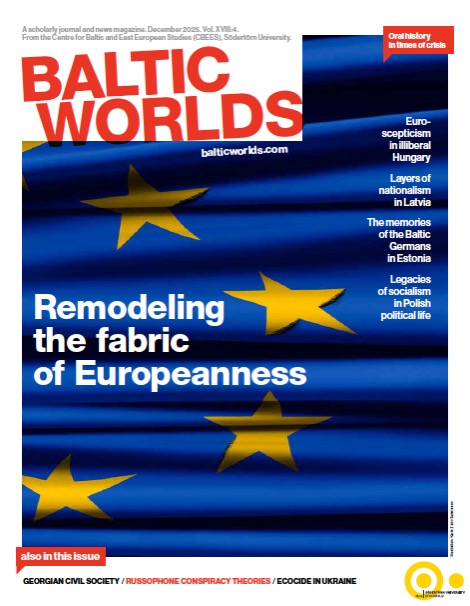 Issue 2025, 4:
  Baltic Worlds covers; the Baltic Sea Region, Eastern Europe, Russia, CentralAsia, Caucasus and the Balkan area.