CBEES Annual Conference: “Shaping Futures: The Baltics and Eastern Europe in the World” November 28-29, 2024
The 10th CBEES Annual Conference offers a time of retrospection and a time of new imaginings – a time to […]

A scholarly journal from the Centre for Baltic and East European Studies (CBEES) Södertörn University, Stockholm.
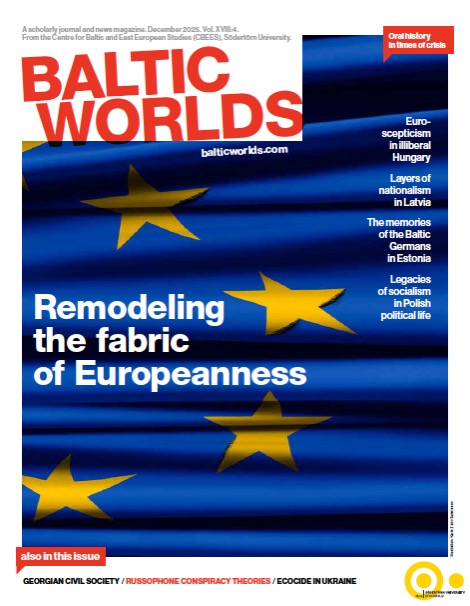 Issue 2025, 4: Download.
The 10th CBEES Annual Conference offers a time of retrospection and a time of new imaginings – a time to […]
Margareta Tillberg has died, at the age of 63 years. Margareta Tillberg had a great commitment to what she did, and she still would have had a lot to give of her knowledge.
Countries in the Baltics and Central and Eastern Europe have been called home by some of the great composers of music history, and the region hosts some of the world’s most prestigious higher classical music education institutions. Despite this fact, Liisamaija Hautsalo states in her essay, the last of this section, that the Finnish-born composer Kaija Saariaho was perceived as being from “a faraway periphery” when she moved in the classical music circles of France, Germany and the US. In a scholarly context I was recently told that (post-communist) Central and Eastern European institutions are not representative of European higher classical music education. The person making this statement obviously assumed that European higher classical music education happens in the UK, or maybe in Germany and Austria. While I did not agree, this feedback speaks volumes about how classical music and higher classical music education is constructed as belonging to Western Europe in international academic debate today. In this special section the authors wish to problematize the role of nation and gender in higher classical music education, and the classical music contexts this education operates in, by focusing on the Baltic and Central and Eastern European region. By doing so we put the assumed Western European identity of classical music and higher classical music education in question.
At the upcoming CBEES Annual Conference 2024 (Södertörn University, 28–29 November) there will be a roundtable discussion on academic area studies journals related to the Baltic Sea region, Eastern Europe and Central Asia, organised by Ninna Mörner (Baltic Worlds) and Joakim Ekman (CBEES, Södertörn University).
This is a presentation of three original public opinion surveys covering the Baltic states, that were recently released in the public domain. All three surveys have been designed specifically to tap the political culture of Estonia, Latvia and Lithuania, including the Russian-speaking poulation groups and other domestic ethnic minorities.
This special section in Baltic Worlds is the result of a workshop engaging with the politics of aesthetic historicizations, through the grid of the monument.
Call for Abstracts (until January 31, 2024) for the Special Issue of Baltic Worlds "Sounds in times of war. Popular Music, (contentious) politics and social change since Russia's war on Ukraine"
On March 27—30, the Baltic University Programme (BUP) organized the BUP Master Thesis Training 2023. 22 master students from the BUP participating universities attended the event, which took place at the Geocentrum at Uppsala University.
Kulturarv: en begreppspolitik [Cultural Heritage: the politics of the concept], Johan Hegardt and Marcia Sá Cavalcante Schuback, (Södertörn philosophical studies, 2022), 124 pages.
2015, amid the summer of migration, the house was founded by writers Sven and Elke Lager who got access to the building from the City Mission. The wish was to contribute with solutions for the topic on everyone’s lips: refugee integration. By then, Give Something Back To Berlin (GSBTB) had already made us a name in migrant support circles. Since 2013 we had built up a big grassroots movement of volunteering and skill-sharing all over Berlin. GSBTB was by no means a refugee project, it was a migrant led-community project that simply reacted to the current needs of the city. One of the most pressing was for modern and human-centered activism supporting newcomers. Also, meet the refugee helpers: Bärbel Heinrich shares her story when she was imprisoned for helping people escape the GDR.
 Baltic Worlds covers; the Baltic Sea Region, Eastern Europe, Russia, CentralAsia, Caucasus and the Balkan area.