Baltic Worlds has in this special section “New Age and alternative beliefs in socialist Eastern Europe” invited scholars from different disciplines to address topics relating to the diversity of new religious beliefs in Eastern Europe during the socialist era and beyond. The authors, five scholars studying the multiple expressions of New Age spirituality on their own material, propose to view New Age from various angles.
Essay by
Anna Tessmann
January 24, 2022
To create a positive image abroad of a certain country many countries invest a lot or resources to promote themselves. However citizens are not always aware of the activities the authorities tasked with this mission by their government carry out abroad. In this essay therefore we will investigate to what extent the official country promotion coincides with the vision of the country's citizens in the cases of Ukraine and Sweden. The aim of this essay is to investigate the experience of representatives of Sweden and Ukraine regarding the promotion of countries.
By
Roman Balandiuk
December 16, 2021
Two panels on memory laws were arranged the same day as part of the annual series of on USSR 30 years after (1991-2021). The panel “Dealing with the totalitarian past: Laws on memory and legislation” took up how different countries have approached the Soviet past in legislation and by “memory laws”. The panel “Memory laws: an interregional perspective on commemoration and legislation” followed this theme up. An aspect discussed throughout the whole event was the Western vs. Eastern models of memory laws.
By
Cagla Demirel and Martin Englund
June 13, 2021
Preliminary Programme (links, dates, and hours to be specified, all subject to eventual changes) In December 1991, the Soviet […]
By
Ninna Mörner
February 23, 2021
CfP: Please submit before February 20, 2021 on the New Age-related topics suggested here.
By
Ninna Mörner
January 18, 2021
The Centre for Baltic and East European Studies, CBEES, arranges a series of multidisciplinary roundtables during 2021 with a focus on the 30 years period since the dissolution of the Soviet Union.
By
Irina Sandomirskaja
January 18, 2021
The outbreak of the Corona virus pandemic has led to a number of legal measures, varying in time and space, over the Baltic Sea area and neighboring states. But the actual distribution of the pandemic does not necessarily follow the administrative territories that form the statistical basis for decisions. While usually defined for specific territories (whole states or administrative areas), the effects on peoples’ daily behavior have been particularly strong in the borderlands. In March 2020, suddenly a sharp line was created along the hitherto almost invisible border between Tornio-Haparanda, Finnish police and border guards checked the line, and only a few people were admitted to cross, based on strict definition of purpose. The reason for the closure was a high incidence of illness and deaths in Sweden.
By
Thomas Lundén
December 1, 2020
The purpose of this theme section is to put the question of religion into the focus of the studies which approach different aspects of Ukrainian reality today and show how an analysis of an intricate interplay between religion, politics, and society can help us better understand this reality. The articles and interviews show the importance of including religion in the studies of societies and look closer into complex entanglements that reveal religious traces, sometimes in the most unexpected places.
By
Yuliya Yurchuk
October 8, 2020
Political institutions in a hegemonic authoritarian regime like Belarus tend to be downplayed, if not entirely ignored. While authoritarian regimes can sometimes masterfully direct constituent assemblies and other such fora, they represent a singular, politically-charged location within which protest energy and opposition efforts can be focused. Uncertainty is the enemy of autocrats and any chance for unwelcome deviations from a prescribed line can prove to be deeply destabilizing.
By
Julian G. Waller
September 22, 2020
An interview with three researchers at Södertörn University; Nikolay Zakharov, senior lecturer in sociology, Per Anders Rudling, associate professor of history and Andrej Kotljarchuk, historian at the Institute of Contemporary History at Södertörn University.
By
Sophia Nilsson
September 21, 2020

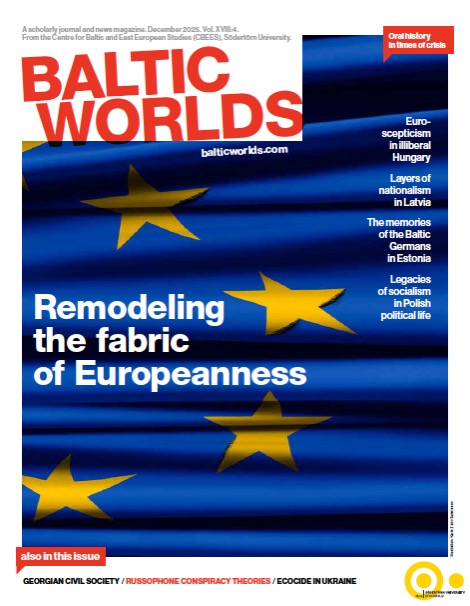 Issue 2025, 4:
  Baltic Worlds covers; the Baltic Sea Region, Eastern Europe, Russia, CentralAsia, Caucasus and the Balkan area.